Celebrating Tahlequah’s Cherokee National Holiday and Understanding Tribal Court Jurisdiction
Tahlequah’s 74th annual Cherokee National Holiday brought Cherokee citizens, families, neighbors and visitors together September 4-6, during the 2026 Labor Day weekend. Centered on the theme, “Together: A Legacy of Community, Family & Culture,” the holiday commemorated the signing of the 1839 Cherokee Nation Constitution; an important milestone in the re-establishment of Cherokee government following the Cherokee Nation’s after forced removal from the Southeast. [1] [2]
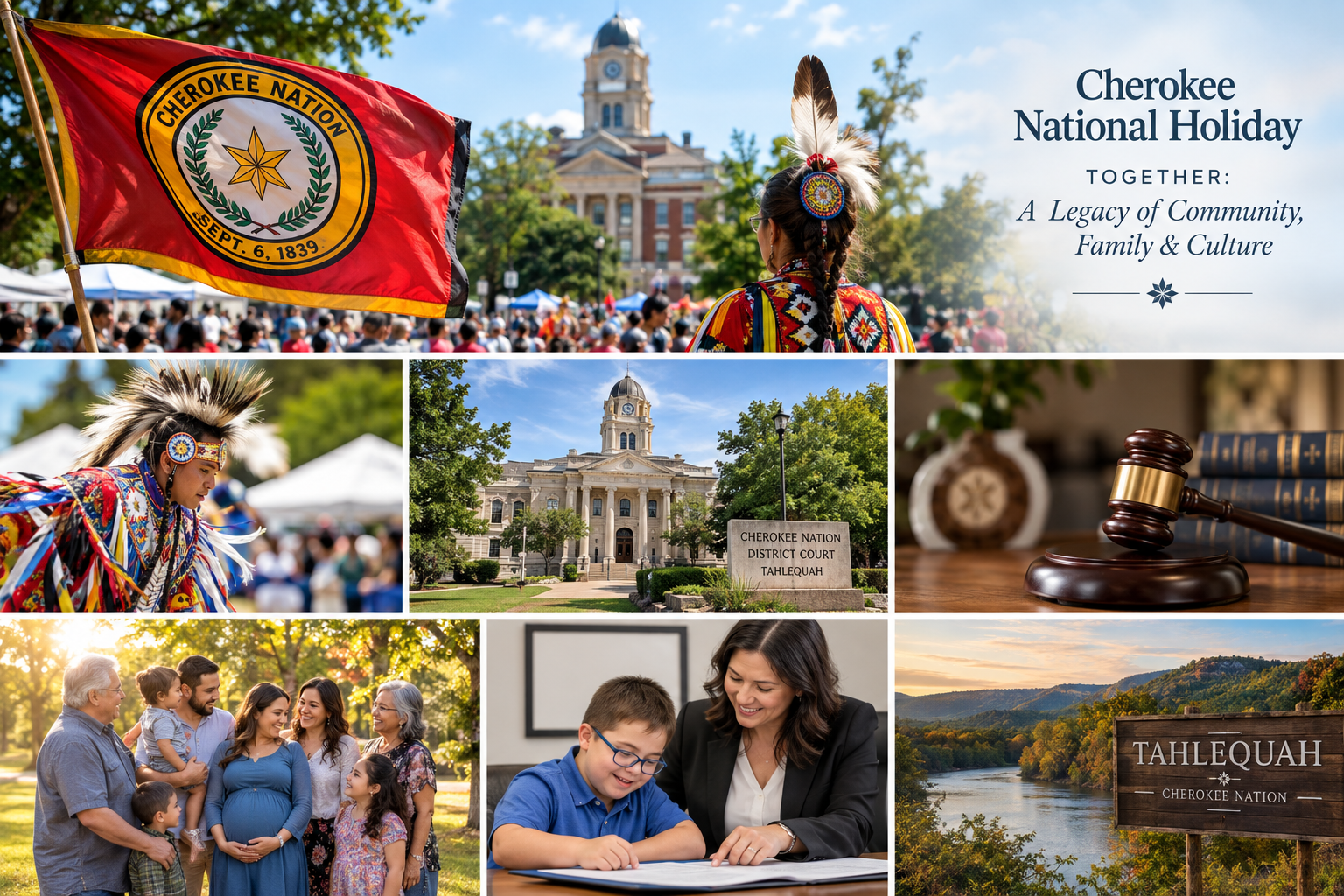
With the parade, inter-tribal powwow, traditional games, music, art, food and community gatherings, the holiday is much more than a local event. It is a reminder that Tahlequah is the capital of the Cherokee Nation; a living community and a sovereign tribal government with its own laws, courts and legal processes. [2] [3]
For families and individuals facing a legal issue involving Cherokee Nation citizenship, tribal programs, child custody, adoption, guardianship or tribal land, that sovereignty can have a direct impact on where a case should be handled.
Tahlequah’s Role in Cherokee Nation
Each year, the Cherokee National Holiday brings people to Tahlequah from across Oklahoma and the country. Cherokee Nation has described the annual celebration as drawing more than 100,000 visitors, with more than 250 food and craft vendors for the event.[2]
That gathering highlights Tahlequah’s ongoing role as the governmental and cultural center of Cherokee Nation. Cherokee Nation is not simply a historic or cultural organization; it is a federally recognized sovereign tribal government with executive, legislative and judicial branches. Its court system serves an important role in matters governed by Cherokee Nation law.[3]
For someone trying to make sense of a legal problem, the first question may not be, “Who is right?” It may be, “Which court has the authority to decide this?”
What Is Cherokee Nation Tribal Court Jurisdiction?
Cherokee Nation Tribal Court jurisdiction is the legal authority of Cherokee Nation courts to hear and decide a particular case.
Whether a legal matter belongs in Cherokee Nation District Court, an Oklahoma state court, federal court or more than one court depends on the facts. A case may involve questions about:
-
- The type of legal claim or proceeding
-
- The citizenship or legal status of the parties
-
- Where the relevant events occurred
-
- Whether the matter involves tribal land, tribal programs or Cherokee Nation governmental interests
-
- Applicable Cherokee Nation statutes, federal law and Oklahoma law
-
- Existing court orders or prior proceedings
Living in Tahlequah or having Cherokee heritage does not automatically mean a case belongs in Cherokee Nation Tribal Court. Jurisdiction is fact-specific, and the right legal forum can affect deadlines, required notices, available legal remedies and the enforceability of a court order.
Cherokee Nation courts generally serve individuals and entities within the Nation’s 14-county jurisdiction in northeastern Oklahoma, unless Cherokee Nation law specifically limits that authority. However, whether a particular case may be filed in the Cherokee Nation District Court depends on the specific facts, the court’s jurisdiction under Cherokee Nation law and applicable federal law. Within its authority, the Cherokee Nation District Court hears civil, criminal, and juvenile matters, while the Cherokee Nation Supreme Court reviews appeals and handles other matters assigned by law. [3]
Where Is Cherokee Nation District Court?
Cherokee Nation District Court is located in Tahlequah at:
17675 S. Muskogee Ave., Second Floor
Tahlequah, Oklahoma 74464
The Cherokee Nation Judicial Branch also maintains a court location in Jay, Oklahoma. The Cherokee Nation Court Clerk’s Office lists 918-207-3900 for procedural court questions and provides resources such as a public case-information portal, court forms, rules, e-filing information, and virtual-hearing instructions.[3]
Court personnel can provide procedural information, but they cannot offer legal advice about where a specific case should be filed or whether Cherokee Nation Tribal Court has jurisdiction.
Does ICWA Apply to Child-Custody Cases?
The Indian Child Welfare Act, commonly called ICWA, may apply when a child-custody proceeding involves an “Indian child” as defined under federal law.
ICWA can apply in cases involving:
-
- Foster-care placement
-
- Termination of parental rights
-
- Pre-adoptive placement
-
- Adoption proceedings
The law establishes minimum federal standards intended to protect the best interests of Indian children and support the security and stability of Indian tribes and families.[4]
In Oklahoma, an ICWA issue can arise in a state-court proceeding, a tribal-court proceeding, or a situation involving both systems. Questions may include whether Cherokee Nation must receive notice, whether the Nation may intervene, whether a case may be transferred to tribal court, and what placement preferences or legal standards apply.
When a child may qualify as an Indian child under ICWA, including a child who may be a Cherokee Nation citizen or eligible for Cherokee Nation citizenship, seeking legal guidance early can help prevent procedural issues and protect important rights. Parents, grandparents, guardians and prospective adoptive families should speak with an attorney as soon as possible, particularly before a hearing, filing deadline or custody order is entered.
Speak With a Tribal Law Attorney
If your matter involves Cherokee Nation law, tribal citizenship, a child-custody dispute, adoption, guardianship, an ICWA question or possible Cherokee Nation Tribal Court jurisdiction, do not assume the Oklahoma state-court system is your only option.
Green Country Law Group is a tribal court attorney law firm that can review the specific facts, identify the court or courts that may have authority, explain important filing and notice requirements and help you take informed next steps under tribal, state and federal law.
Need guidance about a Cherokee Nation Tribal Court or ICWA-related matter? Contact our tribal legal team to discuss your situation and determine the appropriate next step.
This article provides general information only and is not legal advice. Tribal jurisdiction and ICWA matters depend on the facts of the individual case, the parties involved, applicable laws, and any existing court orders.
References:
[1] Cherokee Nation. (2026). Cherokee National Holiday: About. https://thecherokeeholiday.com/about/
[2] Cherokee Nation. (2026, August 6). Cherokee Nation celebrates 74th Cherokee National Holiday with events on Labor Day weekend. Anadisgoi. https://anadisgoi.com/index.php/culture-stories/cherokee-nation-celebrates-74th-cherokee-national-holiday-with-events-on-labor-day-weekend
[3] Cherokee Nation Judicial Branch. (n.d.). Cherokee Nation courts. Retrieved September 14, 2026, from https://www.cherokeecourts.org/
[4] U.S. Department of the Interior, Bureau of Indian Affairs. (n.d.). Indian Child Welfare Act. Retrieved September 14, 2026, from https://www.bia.gov/bia/ois/dhs/icwa